
Ads to “Check your super” and “save fees on super” have led thousands of Australians to invest in fraudulent managed investment schemes, theoretically regulated by ASIC. In the case of the Australian Fiduciaries Ltd collapse, a former ASIC employee and managed investment scheme directors used fraudulently obtained super savings as a slush fund to invest in whatever they fancied - including making horror movies and paying tax bills. The money chain from super fund to lost savings, shows no regulator acted. This is why SVA believes regulatory and defective administration should be covered by the Scheme for Compensation for Detriment caused by Defective Administration (CDDA).
They checked the register. They lost their super anyway.
Treasury wants ASIC to collect better data on managed investment schemes. Scam Victim Alliance backs the plan, but more than 500 everyday Australians have already learned the hard way that data means nothing if no one acts on it.
This submission refers to Australian Fiduciaries Limited (AFL), which is the subject of ASIC Federal Court proceeding QUD371/2025 and is in liquidation. Victims' details are de-identified and shared with their full consent.
A good plan with one big blind spot
Most people assume a fund on ASIC's register can't be part of a fraud. The collapses of Australian Fiduciaries and First Guardian prove otherwise, and Treasury's new proposals only work if they come with action and a way back for victims.
Treasury is exploring new ways to give ASIC better information about managed investment schemes (MIS). Right now, ASIC mostly looks at a scheme when it registers and then again when an annual report arrives a year later. That gap is where people's retirement savings disappear.
Most of the people we represent were talked into rolling their industry super into a new self-managed super fund (SMSF) by advisers who appeared to be licensed. Their SMSFs then invested in ASIC-registered schemes that later collapsed. Many of them now fall through every safety net: the Compensation Scheme of Last Resort, AFCA, Act of Grace payments and the CDDA scheme. That pushes the cost onto the Age Pension and the taxpayer.
What Treasury is proposing, and where we stand
ProposalWhat it would changeOur position1. Richer registration dataFunds open to everyday investors tell ASIC more when they register: strategy, related parties, leverage, liquidity, auditors, withdrawal terms and fees, and keep it up to dateSupport, with additions2. Quarterly reportingOne quarterly report covering money in and out, investor types (including SMSFs), assets and related-party dealingsStrongly support3A. Notification for unregistered schemesWholesale-only funds tell ASIC when they start and stop, who runs them and what they invest inSupport, but make it mandatory with penalties3B. Limited data for unregistered schemesSome regular data, such as assets, redemptions and where distributions come fromSupport, at least for any scheme taking rollovers from super
Our three big asks
Follow the super. Design data collection around how super money flows into schemes each year, and publish the results.
Follow the fraud. Look at how money actually leaves: through special purpose vehicles, unregistered schemes and offshore "investments". Make sure the licensing details of people selling these schemes are accurate.
Give victims a way back. When the regulator sees a problem and doesn't act, people need redress that doesn't mean paying for their own court case.
How a "safe" super switch cost 570 Australians their retirement
Cold calls, Facebook ads and the promise of "social housing" for people with disability. Australian Fiduciaries used ASIC registration as a badge of trust, then moved investors' money where no regulator was looking.
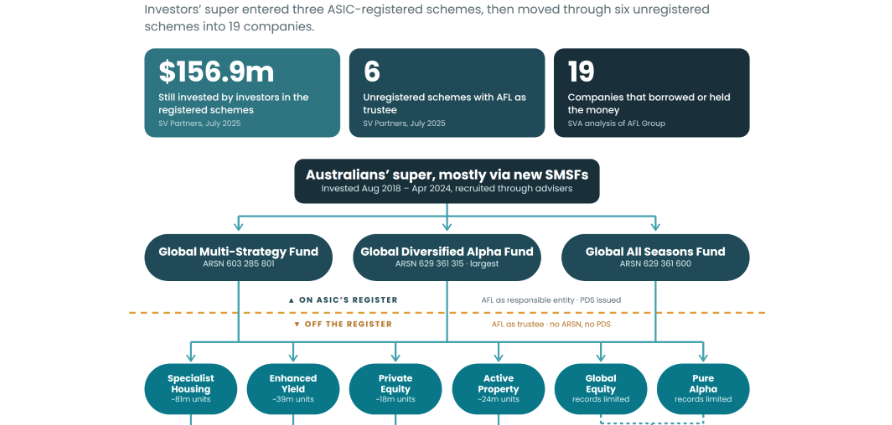
Australian Fiduciaries Limited (AFL) was a Brisbane-based responsible entity holding an Australian financial services licence from December 2014. It ran three ASIC-registered schemes and at least six unregistered ones. Media reports say director Lee Rushton left for Malaysia.
Investors were told their super would fund housing for people with disability, and that "pooling" their super would cut fees and beat their industry fund. Many were nurses. They did the checks most people would think to do, and the schemes passed.
$156.9m still invested when administrators were appointed
~570 people who lost their super
6 unregistered schemes with AFL as trustee
19 companies that borrowed or held the money
Where the money went
Your super Rolled into new SMSFs, 2018–2024
3 registered funds On ASIC's register, with a PDS
6 unregistered funds Off the register. No ARSN, no PDS
Related companies $81.8m to Impact Fiduciaries, ~$40m to Global Yield
The registered funds changed names twice between 2019 and 2023. One disclosure document quietly changed a fund from "liquid" to "likely to be deemed not liquid". Administrators later said every unit class was very high risk, not the "medium to high" risk investors were told.
Ms K, a nurse: "I believed ASIC registration meant it was safe"
Ms K clicked a Facebook ad and booked a Teams meeting with an adviser who told her an SMSF was safe, low risk and her best option. He waved away a "small conflict of interest". After near-daily pressure she rolled over more than $461,000 into AFL schemes in January 2023.
No warning ever came from ASIC, AFCA, her adviser, AFL or Macquarie. She found out from her accountant in June 2025. AFL kept debiting her account for four months after liquidation.
Her depression and anxiety have worsened, her relationship has ended and she has needed food relief, Centrelink and loans from family. She has stopped planning for retirement and believes she will have to work forever.
Mr S, a businessman: he spotted the warning sign and was told it was fixed
Mr S was contacted by Compare Your Super in 2022 and steered into an SMSF by an adviser working under APT Strategy's licence. A web of firms made it look safe: one set up the fund, another ran it, Macquarie held the bank account and Perpetual was named custodian.
Before investing he found ASIC's earlier stop order on AFL. His adviser said it was a "technical issue" that had been fixed. In June 2023 he rolled over about $580,000. No warning came until an ASIC email told him liquidators had been appointed.
Mr S wants ASIC to:
give investors an independent, plain-English risk report before any large SMSF rollover
act on the rollover and complaint data it already holds, before schemes collapse
create clear paths to redress that don't force victims to fund their own fight
Every regulator held a piece of the puzzle. No one put it together.
ASIC had misconduct reports. AFCA later had a growing pile of complaints. The ATO registered the SMSFs. The money kept flowing for years, until it was gone.
Where the money went
Industry super fund member Savings rolled out into a new SMSF
APRA: sees the money leave, not where it goes next
Lead generator: Compare Your Super First contact for 20 of 23 people we surveyed
ASIC: 10 misconduct reports, 2022–24. Lead generation sits outside licensing
Adviser: APT Strategy Recommended an SMSF invested in AFL funds
ASIC: 7 misconduct reports, 2022–24. AFCA: 25 complaints by end of 2024
New SMSF Set up between 2020 and 2023 to buy AFL units
ATO: registers the SMSF, but secrecy rules limit sharing with ASIC
3 AFL registered schemes 1,274 investor holdings, about $165m
ASIC: registration data and annual accounts, a year behind
6 AFL unregistered schemes Received investor money from the registered funds
No regulator. No duty to notify or report anything
Related-party loan notes About $81.8m and $40m to related entities
Uncovered by administrators in July 2025, after the money had gone
Sources: AFL administrators, July 2025; ASIC FOI 2627-037; SVA survey.
AFCA complaints about APT Strategy rose from 1 in 2022 to 3 in 2023, 21 in 2024 and 37 in 2025. AFCA referred an unpaid determination to ASIC in April 2024. At no stage did ASIC, AFCA or the liquidators tell unit holders what to do next. AFL kept taking new money until around April 2024.
Then it got worse. APT Strategy was deregistered in January 2025, which shut 15 complainants out of AFCA and the CSLR. ASIC only officially told victims about their losses in March 2026. Victims had to fund court filing fees themselves to revive the company in June 2026, while still paying fees on SMSFs that held nothing.
The lesson: Quarterly data only reduces harm if it's joined to the warning signs regulators already receive: misconduct reports, AFCA referrals and complaint trends. Regulators must be expected to disrupt serious fraud before it reaches hundreds of people.
First Guardian: $446 million and a red flag in plain sight
The same blind spot, on a bigger scale. ASIC's own register listed an auditor that had already been deregistered, yet thousands more Australians kept rolling their super in.
On paper, the First Guardian Master Fund was a registered scheme run by Falcon Capital. In practice, its own disclosure documents said money would flow into unregistered funds, also run by Falcon. Once super went in, it left the part of the system that reports to ASIC.
Lead generators Cold calls and super "health checks"
Advisers One network alone put ~$296m into First Guardian
Platform or SMSF Super rolled out of APRA funds
First Guardian Registered scheme run by Falcon Capital
Unregistered funds Beyond ASIC reporting
ASIC has alleged around $274m of the fund's value was cash receivables, much of it overdue and unpaid, and that $23m+ appears to have been paid to entities said to provide marketing services. When liquidators were appointed in April 2025, about $446 million of Australians' super was outstanding.
The auditor that didn't exist
ASIC's register listed Audit Services Plus Pty Ltd as the fund's auditor from 2020. That company was voluntarily deregistered in June 2022. In 2025 ASIC acknowledged the detail was wrong, saying the fund was still supplying audit reports from Auditeo, which ASIC has since taken to court.
A deregistered auditor on a fund's registration papers should have been an obvious red flag, one that could have protected thousands of people who rolled over their super after 2023.
Treasury's paper reveals ASIC isn't even told when wholesale-only "unregistered" schemes exist, and they hold around $1 trillion. We accept capital markets need to flow. But when these schemes take compulsory superannuation, Australians should expect the regulator to step in and stop outright fraud.
When the regulator fails, victims pay the bill
There's a scheme designed to compensate people harmed by government failures. For ASIC, no one has been authorised to use it since 2015. We want that fixed.
The Scheme for Compensation for Detriment caused by Defective Administration (CDDA) lets a government agency like ASIC compensate someone harmed by its own delays or failure to act on information. It's meant to put people back where they would have been but ASIC's authorisation lapsed in September 2015 and has never been renewed.
AFL investors have been steered to Act of Grace payments instead. These are entirely discretionary and never decide whether the regulator got it wrong, so there's no accountability and no lesson learned.
Mr K: "Victims deserve substantive consideration of their evidence"
Mr K invested much of his life savings in a property syndicate that later collapsed. In September 2025 he applied under the CDDA for an assessment of ASIC's alleged failures.
"I was told that ASIC officials had not held the necessary CDDA authorisation since September 2015, and Treasury told me it could not determine claims about ASIC's administration," he said. "Even so, in December 2025 a Treasury official issued a determination that no compensation was payable."
He has since had to use FOI requests and Federal Court proceedings just to find out who is allowed to decide his claim. "A compensation scheme offers little real protection if an applicant cannot identify an authorised decision-maker."
What scam victim alliance is asking Treasury to do
Track where the money comes from. Collect data on whether investors' money came from a newly set-up SMSF and which adviser or channel sent it, and let the ATO share SMSF data with ASIC. Cross-check with institutions like NAB, Perpetual and Macquarie.
Report related-party moves when directors have multiple entities and schemes. Registered schemes could report quarterly every investment into an unregistered scheme run by the same operator or a related party, and every related-party loan. This would give ASIC more notice as to when things go wrong and let investors know.
Make notification compulsory. Unregistered schemes must notify ASIC, with penalties, and every scheme name change should be published.
Put victims at the table. Add consumer harm and victim co-design to the guiding principles, and measure success by how fast ASIC acts after the first warning sign. Publish failures openly. Ensure superannuation fraud is prevented by legislation.
Restore the CDDA for ASIC. A standing ministerial authorisation, assessed independently of ASIC, open to claims lodged since September 2015.
Better data increases what ASIC knows. Australians harmed when ASIC doesn't act on that knowledge need a way to have it assessed.
Guiding principles (Q1)
The seven principles focus on industry burden. Add two more: consumer harm prevention (does the data let ASIC step in before people lose money?) and co-design with consumers and victims.
Registration data (Q2–Q4)
We support the proposed fields. Registration should also capture every unregistered scheme the operator or a related party runs; planned sales channels, including referral and lead-generation deals; and a full name history, with changes notified within 14 days. A change in liquidity, a withdrawal freeze or a new related-party exposure should automatically count as a material update.
Recurrent data (Q5–Q9)
We support quarterly reporting, with monthly reporting and fast public warnings for schemes showing risk flags. The most useful fields are:
inflows by source, especially from SMSFs set up in the last 12 months
inflows by sales channel and advice licensee
investments into related unregistered schemes
related-party loans, with security and repayment status
redemption requests versus payments, and any freezes
whether distributions are funded by new investor money
On source of funds (Q8): yes. We recommend a specific exception to tax secrecy rules so the ATO can share SMSF set-up and rollover patterns with ASIC. On cost (Q9): building systems costs money, but not having them costs retirees, taxpayers, the CSLR levy base and the Age Pension far more.
Managed accounts and platforms (Q10–Q11)
Platforms and IDPS operators should be in scope. Many of our members' investments were "hosted" by services whose role they didn't understand.
Unregistered schemes (Q12–Q16)
Wholesale-only schemes should notify ASIC when they start and stop, as a licence condition with penalties. Notification should include name history, the operator, every registered scheme or super fund investing in it, and related-party lending. Regular data is feasible at least for schemes taking money from registered schemes or super. And "unregistered" sounds marginal; "wholesale scheme" better signals real exposure to everyday people's money.
Public data (Q17–Q20)
Publish a searchable register showing name history, responsible entity, liquidity, withdrawal freezes, stop orders and related-party exposures: the facts an SMSF trustee or accountant needs before investing. Commercial sensitivity should not hide related-party lending or liquidity.
Framework and review (Q21–Q23)
ASIC should lead a "report once" model shared with the ABS, APRA and the ATO. A three-year independent review should include consumer representatives and measure: time from first warning sign to ASIC intervention; investors and dollars that entered a scheme after its first warning sign; and how many collapses the data flagged in advance.
Have you lost super through a managed investment scheme? Scam Victim Alliance has offered to connect Treasury officials with members willing to share their experience. If you'd like your voice heard, get in touch.
Guiding principles (Q1)
The seven principles are framed around industry burden when we think an additional lens should be considered:
Consumer harm prevention: data should be judged by whether it lets ASIC intervene before retail and SMSF investors lose money, not only by its cost.
Co-design with consumers and victims: consumer advocates and victim-survivor groups should sit alongside industry in designing fields, thresholds and public outputs.
Registration data (Q2–Q4)
We support the proposed fields, particularly cross-investments, related counterparties, liquidity and withdrawal conditions. We ask that registration also capture:
Every unregistered scheme the responsible entity or a related party operates, and whether the new scheme may invest in them.
Planned distribution channels, including any referral, introducer or lead generation arrangements.
A full name history, with any change of scheme name notified within 14 days. AFL's funds changed names twice; investors and regulators should be able to trace a fund through every label it has used.
The update obligation (Q4) should treat a change in liquidity status, a freeze on withdrawals, or a new related-party exposure as material by definition.
Recurrent data for registered schemes (Q5–Q9)
We support quarterly collections (Q5–Q6). For schemes showing risk flags, such as rapid inflows, high related-party exposure or frozen redemptions, ASIC should be able to require monthly reporting and fast publication of warnings. We believe the most valuable fields for identifying emerging risk (Q7) could be:
inflows by source, especially the share coming from SMSFs established in the previous 12 months;
inflows by distribution channel and by advice licensee;
investments into unregistered schemes operated by the same responsible entity or a related party;
related-party loans and loan notes, with security and repayment status;
redemption requests received versus paid, and any withdrawal freeze;
the source of distributions, including whether they are funded by new investor money.
On source of funds (Q8): yes.
A responsible entity's registry already holds the applicant's name, and an SMSF applies through a corporate or individual trustee. The ATO, as SMSF regulator, also sees new SMSF registrations and rollovers. We recommend a specific exception to the taxation secrecy provisions in Schedule 1 to the Taxation Administration Act 1953 so the ATO can share SMSF establishment and rollover patterns with ASIC. The consultation paper itself identifies that no broad exception currently exists.
On barriers (Q9): the cost of building reporting systems is real but bounded.
The cost of not having them is borne by retirees and taxpayers if they have been defrauded, the CSLR levy base and the age pension.
Managed accounts and platforms (Q10–Q11)
Platforms and IDPS operators should be in scope. Many of our members' investments were "hosted" through SMSF administration services and platforms whose role they did not understand. Portfolio-level data should include the advice licensee and any referral source.
Unregistered schemes (Q12–Q16)
Yes, wholesale-only schemes should be required to notify ASIC at commencement and cessation (Q12). Notification should be a condition of the operator's AFS licence, with a penalty for failure. Baseline notification (Q13) should include the name and name history, the operator, every registered scheme or superannuation entity investing in it, and related-party lending.
Recurrent data (Q14) is feasible at least for any unregistered scheme that receives money from a registered scheme or a superannuation entity. That subset is exactly where retail money reaches the unregistered layer (Q15).
On terminology (Q16), "unregistered" suggests something marginal. A term such as "wholesale scheme" better signals that these are licensed, regulated activities with real exposure to retail money.
Public data (Q17–Q20)
Public outputs should include a searchable scheme register showing name history, responsible entity, liquidity status, withdrawal freezes, stop orders and related-party exposures. These are the facts an SMSF trustee or their accountant would need before investing. Commercial sensitivity should not shield related-party lending or liquidity status from public view.
Framework and review (Q21–Q23)
ASIC should lead collection, with a "report once" model shared with the ABS, APRA and ATO (Q21). A three-year review is appropriate (Q22) if it is independent and includes consumer representatives. The metrics (Q23) should include:
time from first warning sign (misconduct report, AFCA referral, data anomaly) to ASIC intervention;
number of investors and dollars that entered a scheme after its first warning sign;
share of collapses where the collected data showed a risk flag beforeh
Sources
Milliman, Why the Age Pension helps retirees with losses in turbulent times
Governor-General, Scheme for Compensation for Detriment caused by Defective Administration
John Wasiliev, "Inside a $160m super collapse", Australian Financial Review, 15 August 2025
Investment Magazine, "Diversa applies for $239m First Guardian government bailout", 23 April 2026