
24-hour takedowns, verified advertisers for financial and government ads, and intelligence sharing with Australia’s National Anti-Scam Centre: these are the seven reforms we’ve asked the American Federal Trade Commission to adopt.
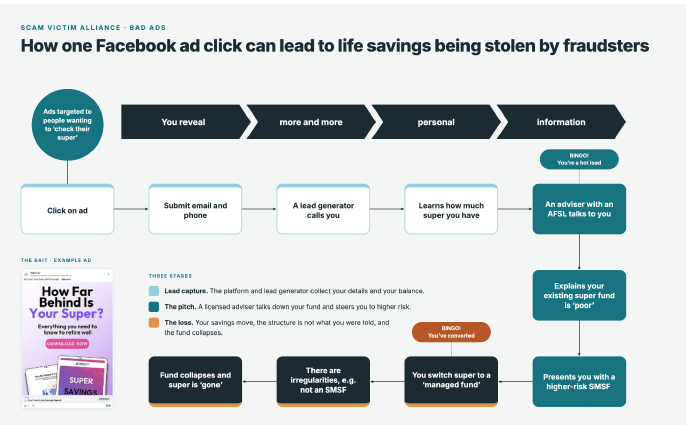
The Australian Fiduciaries Ltd fraud began with deceptive “check your super” ads that appeared to be part of a Government-mandated opportunity to ensure your compulsory retirement savings were earning maximum returns for you. This was a scheme architected to evade regulatory capture which has since ‘collapsed’ and lost retirement savings for hundreds of Australians.
Scam Victim Alliance has urged the US Federal Trade Commission to make digital platforms verify advertisers and stop profiting from impersonation ads, arguing a US rule would set a safety standard wherever Meta, Google and Amazon operate.
About our organisation
We are an Australian volunteer-led community of fraud victims working outside the US jurisdiction. We offer our suggestions in the hope that reform and rulemaking can improve financial and physical safety for everyone around the world.
Our lived experience gives us deep insight into how scammers manipulate digital payment systems, and how individual governments are failing to regulate the banks, telcos and digital platforms to stop criminal networks weaponising financial deceptions that fund global harm.
We believe the digital economy is being compromised by the forces of illicit capital, which unwittingly funds what Interpol has called a “global crisis” of human trafficking and other criminal harm. The financial harm is the smallest part of this problem, and we think the US Government could significantly improve financial safety around the world with rules that disrupt and prevent impersonation.
Introduction: impersonation rules are vital
Scam Victim Alliance (SVA) urges the Commission to proceed with its proposed anti-impersonation rules. The same US-headquartered platforms named in the ANPRM (Meta, Google, Amazon, Apple and LinkedIn) are the front door through which organised crime architects harm all over the world.
A US rule that disrupts the forces of illicit capital by forcing platforms to internalise the cost of impersonation ads would protect other nations, as well as Americans. The safeguards this rule would require could then become a new standard everywhere US digital platforms operate, making people safer, financially and physically, in all parts of the world.
The ANPRM’s central finding, that platforms internalise the revenue but externalise the risk, matches what our community lives through. Victims we support have been reached by Meta ads for a fake “cost of living grant”, by cloned bank websites promoted through social media messaging apps, and by deepfake LinkedIn profiles recruiting for fake jobs that turn into investment scams.
None of our victims received help from the digital platform that carried the ad or the banks that processed the “authorised” payments. Several are now in debt, paying interest on stolen money, or facing criminal charges in Australian courts after being exploited as money mules.
SVA asks the Commission to:
Proceed to an NPRM and adopt a narrowly targeted means-and-instrumentalities provision covering ad-optimisation and targeting services.
Require advertiser and organic profile identity verification before any financial-services, government or bank-branded ad can run or be optimised.
Prohibit platforms from selling, auctioning or optimising ads and organic content against bank, regulator and government brand terms for unverified advertisers.
Impose time-bound duties to investigate and remove reported impersonation ads, with no “price instead of ban” for suspected fraudsters.
Apply the same duties to organic search results and non-ad profiles used to stage impersonation.
Require cross-border intelligence sharing with foreign regulators, including Australia’s National Anti-Scam Centre.
Treat safe-harbour compliance as a floor, backed by redress to victims under section 19.
The borderless nature of modern scam fraud means traditional law enforcement “crackdowns” simply shift the problem to other parts of the globe, where the cost of operation is cheap and easily bought through bribes or “investment”. This hits the most vulnerable communities hardest, forcing the poorest people to carry the highest costs of the scam fraud crisis.
The globalisation of scam compounds and human trafficking means even small nations like Australia face regional disruption from scam compounds setting up shop on our doorstep, in Timor-Leste, Papua New Guinea, Palau and Fiji.
Executive summary: the harm is global, rules are national
The ANPRM’s economic analysis applies outside the United States. Other countries use the same Facebook, Instagram, Google Search, YouTube and app-store ad systems. Scam advertisers buy reach into Australia, and our regulator is already sending US platforms a heavy volume of suspected scam content.
Suspected scam content referred to US platforms by Australia’s National Anti-Scam Centre, 2025
Suspected Facebook scam URLs 7,000+
Google Advertisements 2,098
Google Gmail addresses 844
GoogleOrganic YouTube URLs 14
Part 1: The scam reality of a globalised digital economy
Reuters reporting cited in the ANPRM found Meta earned an estimated 10 per cent of its 2024 revenue, about USD 16 billion, from running scam ads. A later Reuters investigation (15 December 2025) described advertising agencies in Meta’s “Trusted Experts” program helping a reporter run scam ads on Facebook and Instagram.
Our community’s lived experience shows how scammers manipulate digital ads and payment systems while governments and law enforcement scramble to create rules fast enough. All scams, from relationship fraud through to homebuyer scams, rely on four distinct phases (not always linear): lead, deceive, bleed and clean. Each can be disrupted through coordinated national leadership and global collaboration.
An online ad can build a huge pipeline of fraud victims. One fake “ghost” online store can drop-ship genuine items to someone in Australia, Antigua and America, all while harvesting credit card, banking and telco information that makes a person a “lead” for a deceptive scheme.
Authority and threat impersonation. Scams posing as police, regulators and tax officials are escalating into coercive “threat” scams. Fake profiles and pages on platforms are used to make these approaches look official. This is why non-ad content (ANPRM question C.2) must be in scope.
AI-generated impersonation. Deepfake ads using the faces and voices of well-known Australians have run on Facebook and Instagram to sell fake investments. Platform AI tools that generate and assemble ad creative lower the cost of producing these at scale. Where a platform’s own tools build or target the ad, the platform is a participant, not a passive host. Domain registrars and email infrastructure providers also unwittingly participate in schemes architected to avoid regulatory or law enforcement capture.
The money stolen from victims is the smallest part of this harm; what that money funds is the larger problem. Stolen money is the jet fuel that lets crime networks grow and scale at the speed of a social media meme. We urge governments to build survivor-informed solutions into policy responses and to consider the systemic problem holistically, to avoid unintended consequences from rulemaking.
Four lessons from Australia’s Scams Prevention Framework
Australia has legislated a Scams Prevention Framework (SPF) that places prevention, detection, disruption and response duties on designated sectors, starting with banks, telecommunications providers and digital platforms like Google and Meta, which are mostly US-owned but operate in our country. SVA supports all intelligence-sharing, prevention and disruption efforts. Our experience of the SPF rollout offers four lessons for the Commission.
Lessons we have seen in Australia
Carve-outs become the new attack route
Australia’s draft digital platforms code applies to paid search advertising but not to organic search results. Email services were not designated, even though email is a leading contact method in Scamwatch data. Scammers move to whatever is outside the rule. Cloned bank and government sites ranked in organic results look more trustworthy precisely because they are not labelled as ads.
Self-regulation has not worked
Our members report designated platforms refusing or failing to act on reports of scam content, impersonated profiles and account takeovers. Voluntary measures vary by platform (and by bank and telco) and can be withdrawn when scrutiny fades, as the ANPRM itself notes.
Delay costs victims, not corporations, and taxpayers pick up the tab
Under the SPF, external dispute resolution for scam complaints is not due to start until 2027. Every month of delay is another month of losses no one is accountable for, except the taxpayers who fund support and medical services.
Institutions know more than they disclose
In ASIC v HSBC Bank Australia, an uncontested Federal Court matter with orders made in June 2026, the bank’s admissions showed it knew of weaknesses in its scam controls while customers absorbed the losses. Platforms hold the advertiser identity, payment, targeting and complaint records that show what they knew. A rule should require them to keep those records and produce them when investigation or reimbursement is required.
The Commission can learn from the Australian legislative gaps that have led to harm. A US rule that covers both paid and organic channels, and both ad and non-ad content, would set a global baseline that other countries could match.
Part 2: Responses to specific rules and questions
We have focused on the questions where victim evidence is most relevant, drawing on cases and experiences our members have brought to us.
A.3 Do platforms profit from deceptive ads, and what incentive do they have to stop them?
Yes. Platforms are paid when the ad is built, served and clicked, whoever the advertiser is. More importantly, deceptive networks deliberately architect schemes to defraud “personas” vulnerable to specific attacks, and it is these bad actors who profit most.
Sometimes advertisers use cheap targeted ads simply to build a pipeline of people for other complex frauds, including harvesting details through fake stores to steal mobile numbers or card details, or building a detailed persona (such as someone about to buy a home or car). AI now lets bad actors use the same targeting tools on Meta and Google to find people across the globe who are likely to apply for a new job or make a large purchase, where payment can be redirected to mule accounts or crypto networks under criminal control.
B.2(a) Do platforms verify advertisers?
Not in a way that stops impersonation. Our cases show ads and pages run under names unconnected to the real bank, regulator or grant body, with no check that the advertiser, or the digital services a provider carries, is who it claims to be. Fake profiles are easy to set up, as are the payment systems and mule bank accounts connected to advertiser accounts.
Impersonation also reaches telco “verifier” services such as TeleSign, whose failure to detect widespread brand spoofing led directly to a large-scale banking scam that stole from more than 1,000 Australians between 2022 and 2024.
B.2(e)–(f) Remediation and discipline
Members who reported scam ads and fake profiles describe little to no response, no removal, or removal followed by the same scam reappearing under a new account or profile. Pricing suspicious advertisers higher rather than banning them, as reported of Meta, turns fraud into a revenue tier that scales the harms outlined above. Fines, in much the same way governments fine drivers for speeding or running red lights, are a useful deterrent to consider.
C.1(a)–(b) Is ad optimisation an unfair practice?
Where a platform’s tools choose the audience, assemble the creative and bid on a business name or persona, we believe the platform is unwittingly but materially contributing to deception, creating a ripe environment for criminal schemes to flourish.
In Australia, more than 12,000 people were recruited on Meta platforms to “check their super” (the equivalent of a 401(k)) and moved their life savings into fraudulent managed investment schemes that later collapsed. The First Guardian and Shield collapse has been catastrophic, because no regulator, law enforcement agency, digital platform, bank or financial adviser has been held accountable.
That injury is not reasonably avoidable by consumers, who cannot see that the ads were built and aimed by a machine and architected by powerful networks with no legal obligation to refund or compensate the person who clicked. Optimisation reduces marketing costs and helps scale deceptive conduct, letting criminals take the profit before the harm is uncovered. It distorts the cost of doing business.
C.2 Do non-ad posts contribute?
Yes. Fake profiles are especially harmful, and are often hijacked by “bot farmers” running disinformation campaigns. Scam baiters in our community report African and Russian gangs impersonating local businesses in Facebook neighbourhood groups where people buy and sell furniture. These overseas networks use Marketplace to impersonate real Australian-registered companies, especially those with no current web presence, to run elaborate scams. In one case, a real bricks-and-mortar business was firebombed by a scam victim who did not believe the fraud was a digital hoax architected offshore. Non-ad content should be covered.
In police impersonation scams, one victim was kept under continuous Skype video surveillance for a month, with a single call running 12 hours and 26 minutes. She believed she was about to be arrested by Chinese police, and was made to report every two hours and ask permission to shower or use the toilet. The “police” accounts carried no verification, yet impersonated a government agency for weeks. We suggest all digital platforms should:
label accounts that use government or police names and are not verified
detect patterns such as very long, near-continuous video sessions from new overseas accounts to a single user
show in-call warnings, such as “Police do not conduct investigations over video calls.”
C.6 Prevalence
Most victims never report their case. We can share public and anonymised case studies if that would be helpful.
D.2 Barriers to information sharing
Platforms should be required to share confirmed scam-advertiser data across the industry and with foreign regulators. A MATCH-style shared register of banned advertisers, payment instruments and domains looks to be a good model, and we ask the Commission to consider global intelligence sharing.
E.3 Advertiser verification
Yes, it is cost-effective for high-risk categories. Financial services, investment, banking, government services and grants should require verified legal identity and, where relevant, a licence check against the home regulator’s register (for Australia, ASIC’s registers) before any ad runs. This should connect with domain verification as well. Australian regulators have found platform-driven ads consistently produce a “missing delta”, which is also likely defrauded by other businesses in the complex chain of digital marketing platforms and ad stacks.
E.5 Complaint-driven duties
A single credible report from an impersonated bank, a regulator or a victim should trigger investigation. Confirmed impersonation ads should come down within 24 hours, and optimisation services for the advertiser should stop at once. Reports from foreign government agencies should carry the same weight as US reports, particularly from Five Eyes nations.
Case study 1: Graham was scammed to death by deception and impersonation
TRIGGER WARNING: This case study discusses financial abuse, serious illness and death.
Graham, a vulnerable Australian disability pensioner diagnosed with terminal cirrhosis and Korsakoff’s syndrome in 2017, died in June 2025 after systemic financial and digital impersonation abuse by networks based in the United States, Malaysia and the Philippines.
Graham was approached on dating websites and American-owned social media platforms after separating from his wife in 2015. Scammers first posed as romantic partners, then impersonated trusted authorities and manipulated Graham into fake export schemes, including sending PlayStation 5s and Apple gift cards to Malaysia, the United States and the Philippines. His family estimates he lost at least AU$300,000 to AU$400,000 overseas, including disability pension payments funded by Australian taxpayers.
Graham was not only victimised but also manipulated into laundering money for networks based in other countries. Australian banks and government authorities had opportunities to escalate or report his victimisation, yet faced systemic barriers to investigating, despite having complete evidence and contacts for the orchestrators. Graham’s case remains uninvestigated by Australian authorities to this day. The mule account used to launder money offshore was hosted by Australia’s largest bank in October 2025: the same bank that knew Graham was a fraud victim in 2018 and chose to de-bank him, shutting down access in his real name. Graham’s family says there was evidence he had hundreds of mule bank accounts, which he was manipulated into opening to transfer money offshore as part of the many schemes he was co-opted into. The complexity of Graham’s situation means no corporation is held accountable, which amplifies the harm. Graham’s family believes his exploitation led directly to the decline in his health, which only made him more vulnerable to schemes that grow the illicit capital laundered through a global networked economy.
Case study 2: Impersonation on trusted social networks scales global and local harm
Raised in Dubai, Mrs D has experienced four frauds in the decade she has lived in Australia. The most devastating was a $250,000 job scam that began with a job ad on Facebook.
Mrs D believed she was working for Light in the Box, a publicly traded global e-commerce business she had verified as legitimate through its business registrations. She responded to one of multiple ads shown in her Facebook feed.
She then chatted with overseas-based fraudsters, likely working from an offshore scam compound, who knew more about Australian bank fraud controls than she did. Global fraud networks urge Australians to use crypto, which can more easily be laundered and disguised as it crosses borders to fund harm in other nations.
“Neala” was likely a fake profile used in WhatsApp chats to make the Light in the Box job seem real. It is a classic example of how digital schemes impersonate and deceive on multiple levels to steal very real money.
Mrs D is paying interest on the stolen money, and no one has been held to account.
Conclusion
We suggest a global, collaborative approach to building safe systems, as outlined in the graphic below. We also recommend following the United Nations Office on Drugs and Crime’s survivor-informed action brief to tackle fraud.