
Scam victims are being pushed toward bankruptcy by debts criminal networks have created, while people tricked into lending their bank accounts as money mules are being arrested and ordered to repay money they never kept. Here is what we have asked the Treasury to change.
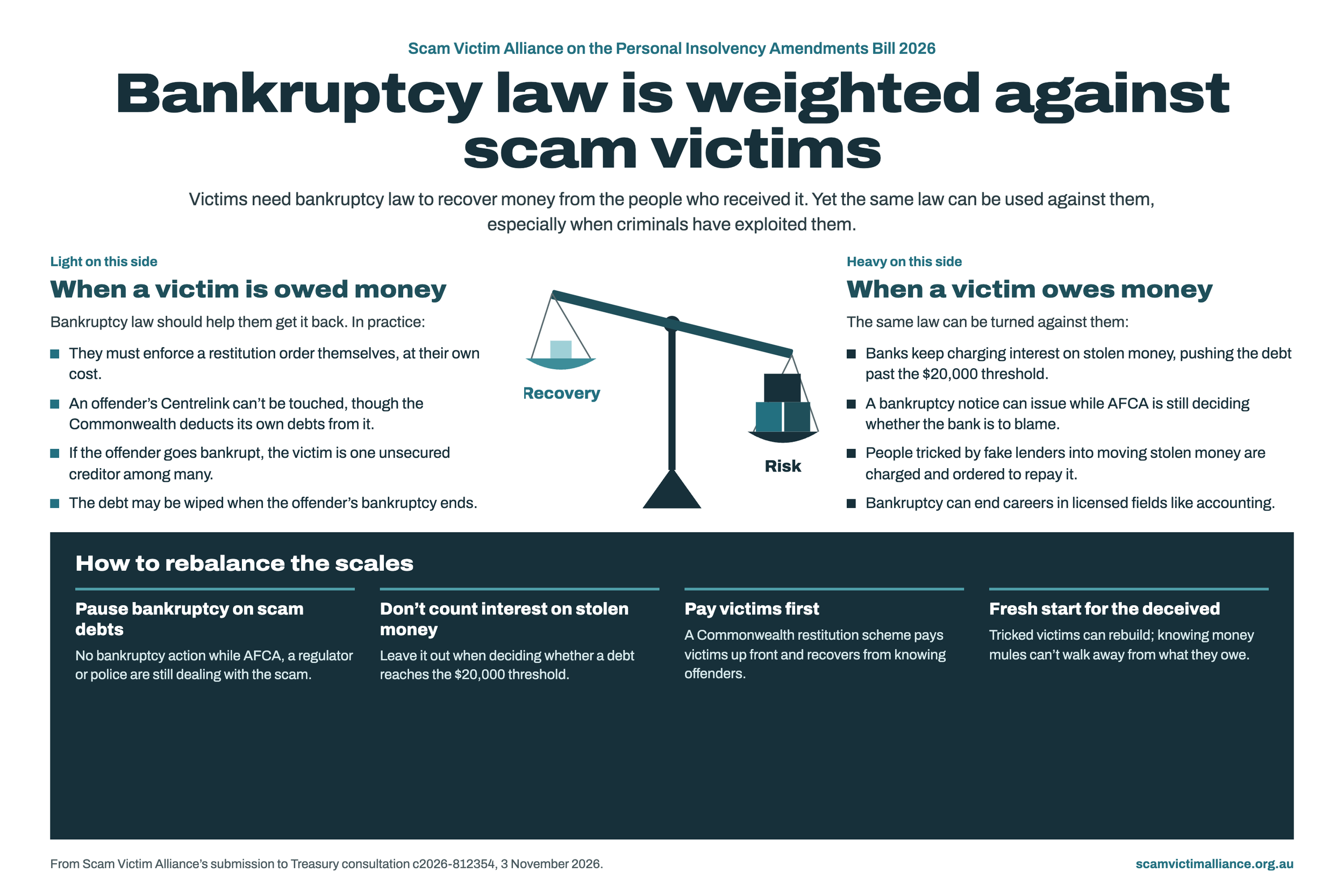
Scam Victim Alliance (SVA) welcomed the opportunity to comment on the exposure draft Treasury Laws Amendment (Personal Insolvency Amendments) Bill 2026.1 We are an ACNC-registered, survivor-led charity supporting Australians who have lost home deposits, savings and retirement funds to scams and fraud through the financial system.
SVA supports the three reforms in the exposure draft. They implement priority reforms first consulted on in 2023 and announced by the then Attorney-General in July 2024.2 We also support the fourth announced reform – limiting a discharged bankrupt’s listing on the National Personal Insolvency Index to seven years – and ask that it not be delayed.
Our concern is that the personal insolvency system has not yet caught up with how many Australians being scammed might end up relying on it. Reported scam losses reached $2.18 billion in 2025, and the downward trend has reversed.3 Scam and fraud losses do not disappear at the time money is stolen: they become mortgage arrears, credit card balances, personal loans or lost superannuation that sometimes keep accruing interest, and for some families they end in forced sales and bankruptcy. Bankruptcy law treats those debts the same as any other.
A newer harm is now reaching our community. Australians who go looking for a loan, a job or help with debt are being drawn in by criminal networks posing as lenders and employers, who use their bank accounts to move stolen money or rely on crypto ATMs, gift cards and other shadow schemes to cause deep financial losses. When police follow the money, it is sometimes these exploited scam victims who are arrested and ordered to pay restitution – not the networks that recruited them, or the banks and financial firms that hosted the mule accounts or money laundering.
The person whose money was stolen
Holds a court order for restitution, and has almost no realistic way to collect it – while often still paying interest on the stolen money.
The person tricked into moving it
Answered a fake lender or job ad, is charged and ordered to repay money they never kept, and is pushed toward bankruptcy.
The system is producing two sets of victims and recovering money for neither.
SVA has asked the Treasury to use these amendments, and its advice to the Minister, to make the personal insolvency system fit for a modern age of AI-enabled scams that are not captured by the new scam prevention laws.
In this submission
Summary of SVA’s position
SVA supports the exposure draft and asks the Treasury to use the final explanatory memorandum, guidance to AFSA and its advice to the Minister to close the gaps outlined in this and our earlier submissions to Government.4
Our asks 5(1) statutory minimum; s 304B (items 1, 7)Raises the involuntary bankruptcy threshold from $10,000 to $20,000, Support, with a safeguard
Exclude interest and fees charged on stolen or scammed balances from the amount counted toward the thresholds 5(1) statutory period
(item 2)Gives debtors 28 days, not 21, to respond to a bankruptcy notice,Support
Pause bankruptcy action on scam-created debts while IDR, AFCA or a police investigation is opens 40(1)(ha), (hb)
(item 3)Debt agreement proposals no longer an act of bankruptcy, Support
Progress regulation of untrustworthy advisers and act on recovery scams targeting victims
National Personal Insolvency Index (announced, not in draft)Limits public listing to 7 years after discharge, Support Do not delay; consult with victim groups
s 153 discharge (contextually related)Discharge releases most debts, but not those incurred by fraud, Clarification needed, Deceived victim-mules should be considered, while complicit and knowing money mules who also obtain Centrelink should have debts that survive
Social security inalienability (contextually related)Income support cannot be garnished for private debts. Outside the draft, but related
A Commonwealth restitution scheme that pays victims first and recovers from offenders, so one system is not “robbing Peter to pay Paul”.
As AI-enabled scams and fraud flourish, we need balance and accountability from financial firms that absolve themselves of responsibility.
AFSA statistics (contextually related)Records causes of personal insolvencyOutside the draft, but relatedAdd scam, money mule and fraud victimisation as a recorded cause of personal insolvency, so scam prevention and disruption are meaningfully linked
Part 1
Scams and fraud are now a cause of personal insolvency, and should be measured
SVA supports each of the three amendments in the exposure draft. Raising the threshold to $20,000 means fewer people are forced into bankruptcy over relatively small debts. Twenty-eight days to respond to a bankruptcy notice is a practical improvement for people in crisis. Removing debt agreement proposals as an act of bankruptcy encourages people to try to settle their debts rather than avoid doing so.
The consultation’s explanatory materials describe people entering bankruptcy for “social, health and economic factors”. Scam and fraud victimisation is not named, and as far as SVA is aware it is not recorded as a cause in AFSA’s statistics. Our members’ experience suggests it should be:
SVA supports homebuyers whose settlement funds have been stolen through scams, and in many cases the bank kept charging interest on the stolen money.5
Some of our victim community are threatened with insolvency after being victimised by scammers, which would then limit their employment opportunities, particularly in licensed fields like accounting.
A Westpac customer held under coercive control by fake authorities for 21 days lost more than $840,000, on which the bank now charges interest but does not have to prove the victim ever signed the papers. Read the published AFCA determination.
If the system does not count these cases, it cannot design for them. The Treasury and AFSA will not know whether the higher threshold and longer response period help scam and AI-enabled fraud victims, or whether scam-driven bankruptcies are rising.
1
Support the exposure draft
SVA supports the three amendments as drafted and asks that the National Personal Insolvency Index reform proceed without delay.
2
Count scam-caused insolvency
AFSA should add “scam or fraud victimisation” to the causes of insolvency it records for bankruptcies, debt agreements and personal insolvency agreements, and report the figures annually so the Treasury can assess whether these reforms and the Scams Prevention Framework are working together.
Part 2
Bankruptcy should not enforce a scam debt while it is still being disputed at AFCA or in court
When a bank’s weak fraud controls let a criminal take a family’s money, the debt that follows – a mortgage balance on money that never reached the vendor, a credit card used by a criminal, a loan drawn under coercion, or superannuation stolen through lead generation into a “collapsed” SMSF – is still legally owed while the family pursues the bank through internal dispute resolution and AFCA. That process routinely takes many months and sometimes years. A creditor can, in the meantime, issue a bankruptcy notice or present a petition, and interest on the stolen amount keeps adding to the debt.
A higher threshold helps, but not if the debt only crosses $20,000 because of interest charged on stolen funds or the compounding of a scam debt over time – for example, through lower superannuation payouts caused by an investment “collapse” that was really a fraud, as happened in the First Guardian, Shield and Australian Fiduciaries collapses.
3
Pause bankruptcy action on scam-created debts
The Treasury should require, through the Bill, regulations, new guidance under the Scams Prevention Framework, or AFSA guidance, that a creditor disclose when a debt relied on for a bankruptcy notice or creditor’s petition is the subject of an open scam or fraud complaint being dealt with by regulators, the financial ombudsman or police. The Official Receiver should not issue, and the court should be guided to consider dismissing, bankruptcy action on such a debt until the complaint is resolved and accountability for the fraud is truly untangled.
4
Do not count interest on stolen money toward the threshold
Interest, fees and charges accrued on a balance attributable to a reported scam or fraud should be excluded when determining whether a debt meets the statutory minimum.
Part 3
Victims who sought out lenders that were really criminal networks are being arrested
SVA’s community now includes people who were themselves deceived and then charged. Typically, a person under financial pressure searches for a personal loan, a job or debt help, and is contacted by what appears to be a lender, recruiter or debt adviser. They are told that to qualify they must “prove repayment capacity” or “process payments”, and are asked to receive money into their own account and pass it on. That money has been stolen from another scam victim. When the theft is reported, police follow the money to the person whose name is on the account.
The major banks have told Parliament this pattern is common. CBA described unwitting mules, who may have been scammed themselves, as the largest share of mule accounts. NAB said an increasing number of mule account holders are themselves scam victims or vulnerable customers who were socially engineered or coerced. Westpac gave the example of a romance scam victim tricked into moving money.6 In FY25 alone, NAB exited 9,364 customer profiles for mule concerns, CBA 3,165 and Westpac 1,373.
For a deceived person, the consequences stack up quickly: a criminal charge, loss of bank accounts, a default on the original loan they were seeking, and a restitution order for money they never kept. Offences such as negligently dealing with proceeds of crime do not require dishonesty, so a person can be convicted for failing to see what a professional criminal network designed them not to see. A restitution order then becomes an unpayable debt, and bankruptcy the likely end point – while the network that recruited them is untouched and the original victim is still not repaid.
Bankruptcy law matters here. As SVA understands it, discharge from bankruptcy does not release a debt incurred by means of fraud (section 153). It is not clear whether a restitution debt arising from a negligence-based offence, committed by someone who was themselves deceived, is released or survives. Either answer has consequences: if the debt is released, a knowing mule can walk away from it; if it survives, a deceived victim may never be able to rebuild their life.
5
Treat deceived mules as victims
The Treasury should work with the Attorney-General’s Department, police and the National Anti-Scam Centre so that people deceived by fake lenders, employers or advisers into receiving scam proceeds are treated first as scam victims: referred to support, diverted from prosecution where there is no evidence of knowledge or benefit, and able to report the scam that targeted them. We also believe outlawing crypto ATMs will help prevent this type of harm.
6
A fair rule on restitution debts in bankruptcy
The Treasury should clarify in the Bill or explanatory memorandum how section 153 applies to restitution and compensation orders for proceeds-of-crime offences. Debts of offenders who knowingly took part or benefited should survive discharge; debts of people the sentencing court accepted were themselves deceived should be capable of release, with the original victim paid through the scheme in Recommendation 9.
7
Access to banking and redress for deceived mules
Under the Scams Prevention Framework, deceived mules should have access to a basic bank account after exit, and to reimbursement and AFCA for losses they suffered in the scam that targeted them, including fees and defaults on loans they were seeking. The National Anti-Scam Centre or a similar authority could monitor these accounts to protect other Australians when money mules rent out their accounts for a quick buck to receive stolen funds.
Part 4
Restitution orders rarely reach victims – especially where offenders are on Centrelink
On 26 October 2026, the Magistrates’ Court of Victoria at Broadmeadows convicted the holder of an account that received $109,350 stolen from a CBA first home buyer two days before settlement. The court ordered restitution of the full amount under section 84 of the Sentencing Act 1991 (Vic), payable by 26 April 2028, alongside an 18-month community correction order.7 AFCA had allowed CBA to keep charging interest on the stolen amount – about $136,000 over the life of the loan – yet the offender’s barrister said the offender had no means other than Centrelink income to pay it back.
A second matter heard in the Melbourne Magistrates’ Court, case R10481916, listed on 13 October 2026 with more than one matter, also resulted in a restitution order with a due date. ASIC records show this offender held director and secretary roles in three private companies registered between April 2022 and January 2025, but also claimed Centrelink benefits.
As we understand it, three features of the current system mean an order like this is unlikely to be paid:
the victim must enforce the order themselves as a civil judgment debt, at their own cost, with no agency collecting it;
social security payments are protected from garnishee orders and private debt recovery under the Social Security (Administration) Act 1999, so a victim cannot reach an offender’s income support – even though the Commonwealth routinely recovers its own debts by deducting from those same payments; and
if the offender becomes bankrupt, the victim is one unsecured creditor among many and, depending on how section 153 applies, the debt may be released on discharge.
Whether the offender knew what they were doing or was deceived, the result for the original victim is the same: a court order and no money, and the chance of falling into bankruptcy themselves. And if the offender was deceived, the order simply moves the loss from one victim to another, poorer one, while the financial firms that opened and operated the infrastructure that enabled the fraud carry no obligation at all.
8
Count the orders
The Treasury should work with AFSA, state courts and police to report how many restitution and compensation orders are made for scam and fraud offences each year, how much is ordered, and how much is paid to victims. This should be counted as part of the Scams Prevention Framework, so the scam problem does not shift into another Government headache of more personal insolvencies.
9
A Commonwealth restitution recovery scheme
The Government should establish an insurance or reimbursement scheme that pays victims holding scam or fraud restitution orders in full and up front, funded by a levy on sectors designated under the Scams Prevention Framework. The scheme would then recover from offenders who knowingly took part, including by modest regular deductions from income support in the way Services Australia recovers Commonwealth debts. Recovery from people the court accepted were deceived and not complicit should be waived, or replaced with counselling on the risks of muling.
10
The receiving bank pays and steps into the order
Where a court finds that money received into an account was proceeds of a scam or fraud, the licensed financial firm that held the receiving account should reimburse the victim’s unrecovered loss and take an assignment of the restitution order, so the institution best placed to collect it carries the collection risk.
Part 5
Debt advice, recovery scams and the people who have already lost money
SVA supports removing debt agreement proposals as an act of bankruptcy. The 2023 roundtable also identified harms caused by unlicensed or untrustworthy advisers as a priority for later work.8 For our community, that work is urgent. People who have lost money to a scam are targeted again by “recovery” services that promise to get their money back for an upfront fee, and by debt advisers who steer people in crisis toward products that suit the adviser. The same networks that pose as lenders in Part 3 can also pose as debt-relief providers.
11
Progress regulation of untrustworthy advisers
The Treasury should set a timetable for the adviser reforms identified at the 2023 roundtable, and include fund recovery and debt-relief services that target scam and SMSF fraud victims within their scope.
12
Point victims to free help
AFSA’s bankruptcy notice and debt agreement information should tell recipients that free financial counselling is available, that genuine services do not charge upfront fees to recover scam losses, and how to report a fake lender, recovery service or debt adviser.
Part 6
Our Scams Prevention Framework recommendations still apply
The Scams Prevention Framework commences on 31 March 2027. Every scam loss it does not reimburse becomes a debt that a family carries, and some of those debts will end in the personal insolvency system. For that reason, SVA restated the recommendations it has made in its submissions on the Scams Prevention Framework and the Banking Regulations 2026, and asked the Treasury to treat them as part of the same policy problem.
Lift SPF mandatory reimbursement from the proposed $3,500 to $25,000, paid at IDR within 5 to 35 days
Freeze interest, fees and collection on fraud-affected balances while IDR, AFCA, police, prosecution or restitution is open; refund if the bank is liable
Design so no more than 3 to 5 victims are harmed by one fraud typology before it is stopped, with every link in the payment chain strengthened
Freeze stolen funds within 12 to 24 hours and trace 3 to 5 hops of mule accounts to reimburse
Return to frozen mule account money that’s traceable back to victims, never to consolidated revenue as unclaimed money
Share verified scam identifiers within 5 business days; typology alert after 3 matching complaints in 90 days
Quarterly public Scam League Table of complaints, recoveries and reimbursements by firm, and most impersonated brands
Flag settlement-bound balances; hold transfers to accounts posing as PEXA or Sympli; explore mandatory settlement cyber insurance and compensation for superannuation rollover into SMSFs that are essentially fraudulent
Hold “term deposit” payments into third-party accounts; standard protocol for customers coerced by fake police, government or bank staff
Do not treat customers as negligent for failing to detect voice clones or forged documents
Ban crypto ATMs and gift cards used in airports
Preserve 6-year common law rights alongside SPF reimbursement; no settlement may silence victims from speaking to regulators, police or ParliamentTreasury, AFCA
Beyond this consultation, SVA continues to call for a Royal Commission or Parliamentary Inquiry into financial crime, and for mandatory scam reimbursement to be lifted to $25,000. We would welcome the chance to give further evidence to the Treasury, and to connect it with the victim-survivors whose cases are described here.
Notes
Treasury, “Reforms to the bankruptcy system”, consultation c2026-812354, exposure draft Treasury Laws Amendment (Personal Insolvency Amendments) Bill 2026 and explanatory materials. consult.treasury.gov.au/c2026-812354 ↩
Attorney-General’s Department, Personal Insolvency Consultation (c2023-682313), September 2023; the Hon Mark Dreyfus KC MP, “Bankruptcy law reforms”, media release, 8 July 2024. ↩
National Anti-Scam Centre, Targeting Scams report, March 2026. ↩
Scam Victim Alliance, Media & Advocacy. ↩
Scam Victim Alliance, submission to the Treasury on the exposure draft Banking Regulations 2026, 30 October 2026. ↩
CBA, NAB and Westpac responses to questions arising from the public hearings of 18 and 19 November 2025, House of Representatives Standing Committee on Economics, Review of Australia’s four major banks. ↩
Magistrates’ Court of Victoria at Broadmeadows, Notice of order made, court reference R10792841, 26 October 2026. ↩
Attorney-General’s Department, Ministerial Roundtable on Personal Insolvency, March 2023, and Personal Insolvency Consultation discussion paper, September 2023. ↩
Scam Victim Alliance, submission to the Treasury on the exposure draft Banking Regulations 2026, 30 October 2026, and SVA’s submissions on the Scams Prevention Framework. ↩