
Threatened with costs: why nsw homebuyers need help dealing with lawcover
Criminals are slipping fake bank details into solicitors' email threads at the moment of settlement. For the families who lose everything, the fight against their lawyer’s insurer is only one part of the battle. Payment redirection losses rose 9.3% in 2025, yet the federal Scams Prevention Framework doesn't cover email. Here's one gap we are asking the NSW Parliament to close to stop life-changing financial losses plaguing NSW homebuyers.
5 reforms the NSW Parliament could consider to help MORTGAGE FRAUD victim-survivors
Does Law Society ownership of the dominant insurer for these crimes create an unmanaged conflict of interest requiring structural separation or independent oversight.
Could genuine market competition would improve claims outcomes and give consumers an alternative to a single gatekeeper.
Whether independently verifiable digital-forensics standards should be mandatory before a "no compromise" finding can be relied on to deny a claim.
Whether higher, mandated trust-account and email-security standards should apply to property settlement transactions.
Whether defrauded third-party consumers should have a standing, cost-protected pathway to challenge a Lawcover denial such as through NCAT or a similar State-based tribunal system.
Mortgage fraud victim-survivors suffer extreme financial losses when organised crime exploits gaps in the system to steal their property settlement funds. These survivors are trapped in an impossible liability circle.
The bank blames the customer. The lawyer points to the criminal. The insurer disputes liability. State police are under-funded and the Australian Federal Police simply run a reporting system tracking what happened, but never chasing the money trail. The victim-survivor homebuyer is left carrying all the financial consequences, along with the shame of being scammed and blamed.
These property misdirection fraud cases raise a larger public-policy question. NSW requires property transactions to operate within a highly regulated electronic conveyancing system, and earns substantial tax revenue from property transactions. Yet when organised criminals exploit weaknesses around that system, who is ultimately responsible for making an innocent homebuyer whole? Certainly not Lawcover.
For the NSW homebuyers who we support after their life-changing fraud loss, their trust in Government and banks is forever broken. They did what Australians are encouraged to do: saved, borrowed and bought a home. Then criminals stole the money intended for their home purchase and no-one accepts any responsibility for the loss.
With only one company allowed to sell insurance to lawyers in NSW, and it being owned by the same group that's supposed to watch over lawyers (the Law Society of NSW), there's no effective insurance to protect citizens from a highly destructive economic crime they can rarely recover from financially or emotionally.
The problem with Lawcover for victims of property misdirection fraud
Imagine being lucky enough to buy a home in NSW, the State with the most expensive house prices. You follow the rules, engage a solicitor or conveyancer, obtain a mortgage and transfer perhaps hundreds of thousands of dollars through a property settlement system you have every reason to believe is safe. Then criminals get inside the communications surrounding the purchase.
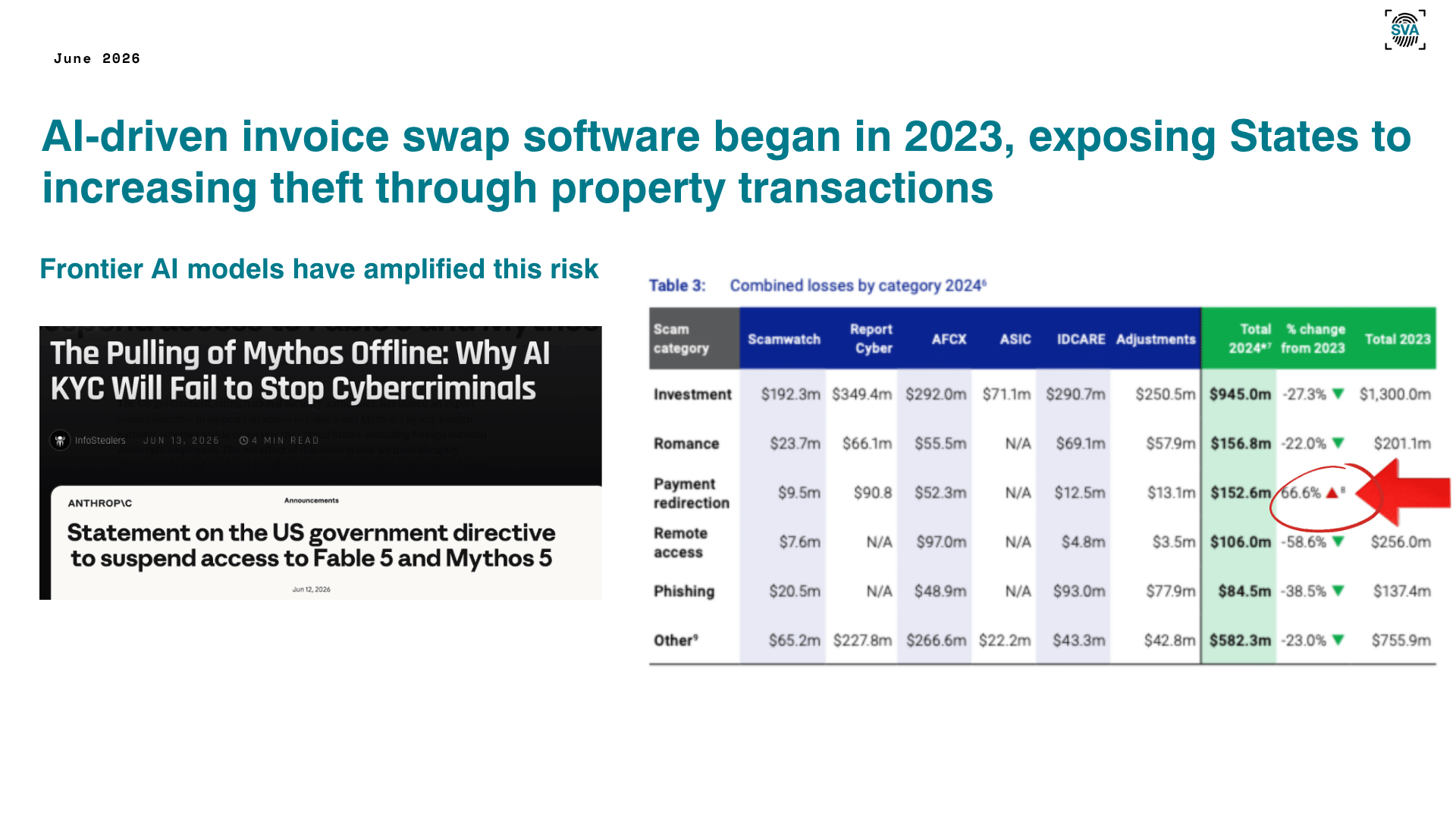
Fraudsters have compromised the lawyer or conveyancer's email, monitored to get the property settlement details and at precisely the right moment, they use AI invoice-swapping software to insert fraudulent bank details into what appears to be the real email of your solicitor. The buyer follows what looks like an authentic instruction and sends their deposit or settlement money to a criminal-controlled mule bank account.
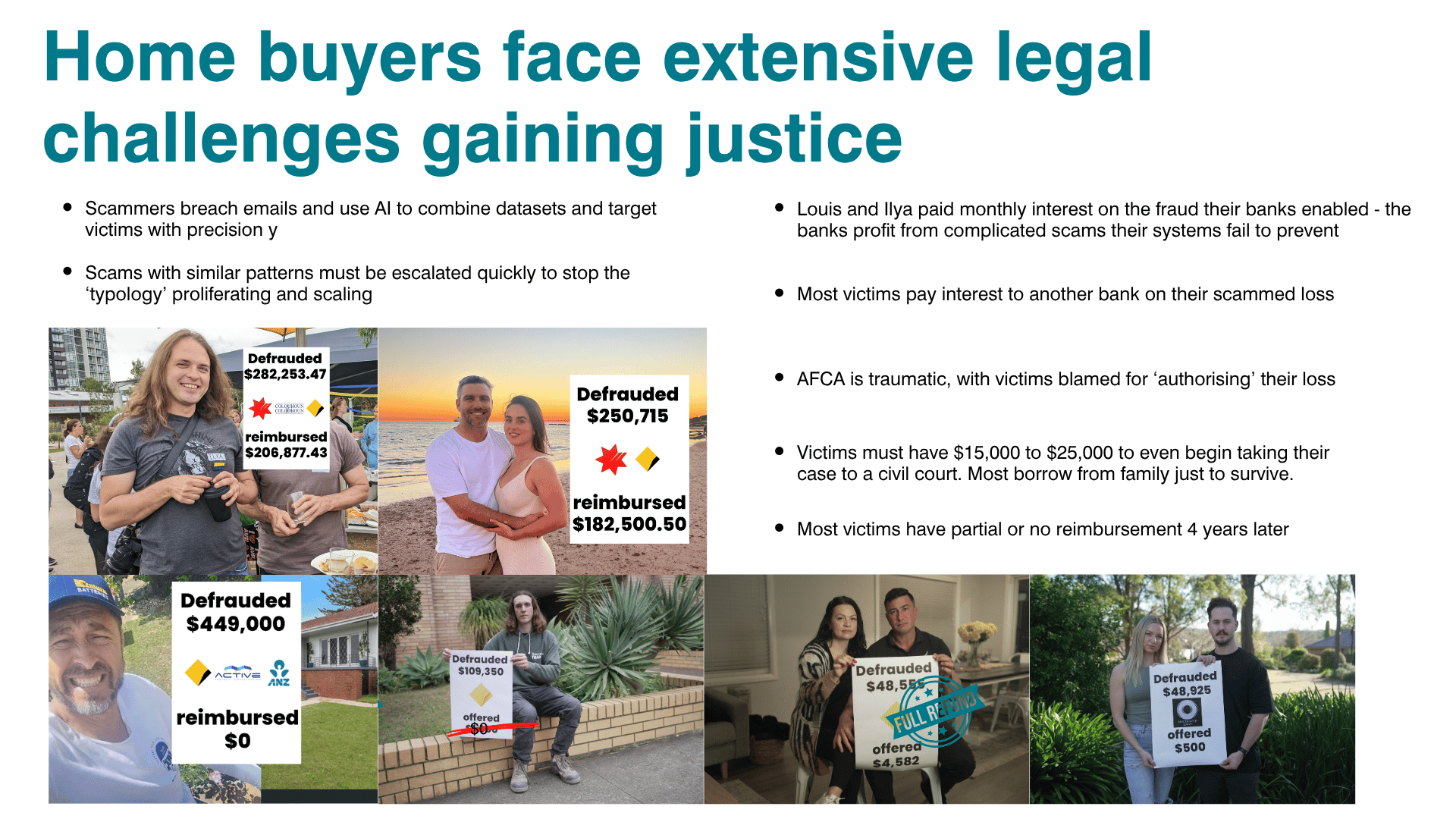
In minutes, a family's life savings can disappear. Many victims lose their property and their deposit. Others borrow money from friends and family and end up further in debt. The banks often capitalise the scammed loss into the mortgage and charge interest on the whole thing.
Banks blame lawyers/conveyancers ... Australian Financial Complaints Authority blames the victim ... Real estate agents keep collecting personal data ... criminals keep winning
When that happens, homebuyers discover there's no such thing as 'safe as houses' in NSW, where solicitors and banks both have licence to blame the homebuyer for falling victim to a crime they have little to no ability to foresee. The bank will blame the customer who authorised the payment. The lawyer will say it wasn't their system that was compromised. Police might investigate the crime but cannot necessarily recover the money when the mule bank account has been created through a fake identity takeover. Meanwhile, the mortgage and interest remains payable.
Then there is the lawyer's professional indemnity insurer, Lawcover. It is owned by the Law Society of NSW, who also says lawyers don't have to show a defrauded customer their IT and email systems were protected.
NSW solicitors are generally required to obtain their compulsory professional indemnity insurance through Lawcover, which operates within the institutional structure of the NSW legal profession. For a devastated homebuyer seeking compensation, this can create an extraordinary imbalance: the consumer has suffered a life-changing loss, but the institutions with the information, insurance and resources needed to establish what went wrong largely control what happens next.
That matters particularly in payment-misdirection fraud. Determining responsibility may require extensive forensic examination of the solicitor's email environment, access logs, cybersecurity controls, warnings and communications. A homebuyer usually has access to none of that evidence. The solicitor and insurer do. So does the bank. Yet no-one helps the homebuyer
SVA submits that this inquiry should look beyond pricing to the human and systemic cost of an unaccountable monopoly, and offers to provide further confidential case material to assist the Committee.
Scam victim-survivors are trapped in an impossible liability circle. The bank blames the customer. The lawyer points to the criminal. The insurer disputes liability. State police are under-funded and the Australian Federal Police simply run a reporting system tracking what happened, but never chasing the money trail. The victim-survivor homebuyer is left carrying all the financial consequences, along with the shame of being scammed and blamed.
These property misdirection fraud cases raise a larger public-policy question. NSW requires property transactions to operate within a highly regulated electronic conveyancing system, and earns substantial tax revenue from property transactions. Yet when organised criminals exploit weaknesses around that system, who is ultimately responsible for making an innocent homebuyer whole? Certainly not Lawcover.
For the NSW homebuyers who we support after their life-changing fraud loss, their trust in Government and banks is forever broken. They did what Australians are encouraged to do: saved, borrowed and bought a home. Then criminals stole the money intended for their home purchase and no-one accepts any responsibility for the loss.
With only one company allowed to sell insurance to lawyers in NSW, and it being owned by the same group that's supposed to watch over lawyers (the Law Society of NSW), there's no effective insurance to protect citizens from a highly destructive economic crime they can rarely recover from financially or emotionally.
2. How Lawcover's insurance monopoly has added to the harm of property misdirection scams for NSW homebuyers
When people buy a house in NSW, the Government forces them to transact electronically through PEXA or Sympli. NSW Fair Trading has acted to try to fix this problem. A Property Payment Redirection Scams Roundtable was held in April 2026 and a national working group is addressing the issue.
Ultimately, Lawcover, like banks, is one of the parties with the power to award reimbursement and demand forensic interrogation of the lawyer's IT systems. However, because Lawcover and the Law Society of NSW are also the same body deciding whether to pay victims back, it's not a fair fight.
Lawcover increasingly threatens victim-survivors with the insurer's costs if they pursue recovery through civil litigation, effectively doubling the financial risk of a homebuyer going down this pathway.
[Image: "NSW Fair Trading is acting but we need Lawcover reform." Photo of the Property Payment Redirection Scams Roundtable, 24 April 2026, alongside the NSW Fair Trading summary document.]
The federal government's new Scams Prevention Framework [4] is designed to protect people from scams. But this exact kind of scam, stealing house-settlement money, isn't covered by those new rules because email is exempt. So even the newest protection doesn't catch this hole.
Meanwhile, the criminals who got away with the money continue to scale their harms, and we see new mortgage fraud typologies emerging all the time.
For many of our victims, the police investigate and find the mule bank account used in the scam wasn't even a real, registered account, so nobody could be charged. No investigation. No court case. The victim loses the money AND nobody goes to jail. This happened to Will and Jess, who bought their first home in Camden back in 2023, and can't afford to move into their home.
Lawcover passes the blame around, nobody is properly checking the forensic evidence, and victims are left with no real place to go for help. Our organisation first raised the complex harms of property settlement fraud with NSW Fair Trading in 2025 and was pleased that Fair Trading Commissioner Natasha Mann escalated it as an issue of national significance. Our charity has assisted a number of NSW and interstate families who lost their life savings, home deposits or settlement funds to property payment redirection fraud, and then subsequently tried to seek recovery or justice from the solicitor's professional indemnity insurer, Lawcover.
This submission goes to paragraphs (a) and (d) of the Terms of Reference: the impact of the current settings resulting in an effective monopoly provider, and other related matters. We ask the Committee to look beyond pricing and into what the Lawcover monopoly, and its ownership by the Law Society of NSW, means in practice for a growing class of consumers: homebuyers and sellers whose settlement funds are stolen through banking mortgage fraud, solicitor email compromise and payment redirection scams.
In August 2026, AUSTRAC [5] uncovered co-ordinated mortgage fraud across 10 Australian banks, with professional facilitation from brokers, accountants and conveyancing professionals referenced in other media articles [6].
3. Homebuyers are being widely dudded, and not just because NSW has the most expensive property market in Australia
Property payment redirection scams are not a fringe problem. The National Anti-Scam Centre recorded $166.8 million in payment redirection scam losses in 2025, up 9.3% on 2024, placing this category among Australia's five highest-loss scam types. Total reported scam losses in Australia reached $2.18 billion in 2025, a 7.8% increase on the year before.
Property-related fraud losses are lucrative, which is why they are a target. New PEXA research [7] reveals homebuyers in 2026 are less confident that they can spot a scam than in 2025. Self-rated confidence fell from 51 per cent in 2025 to just 41 per cent in 2026, despite years of scam-awareness campaigns. Increasingly sophisticated techniques such as AI voice cloning are making the traditional advice to simply "spot the scam" much harder to follow.
When buyers and intending buyers were shown a mock scam email, one in three said they would transfer money to the fraudulent account. Relying on consumers to detect increasingly convincing fraud is not an effective safety system, but neither is the existing courts, law enforcement or Australian Financial Complaints Authority system.
Almost nine in ten Australians rate buying property as one of life's most stressful experiences. Stress, urgency, unfamiliar processes and enormous financial transfers converge at precisely the moment consumers are expected to detect tiny anomalies in otherwise convincing communications. The evidence points to a fundamental problem with placing primary responsibility on the buyer: the more sophisticated scams become, the less realistic it is to expect an anxious homebuyer to serve as the final fraud-detection system protecting hundreds of thousands of dollars. Lawcover has already proven it will join in to deny accountability in these complex crimes.
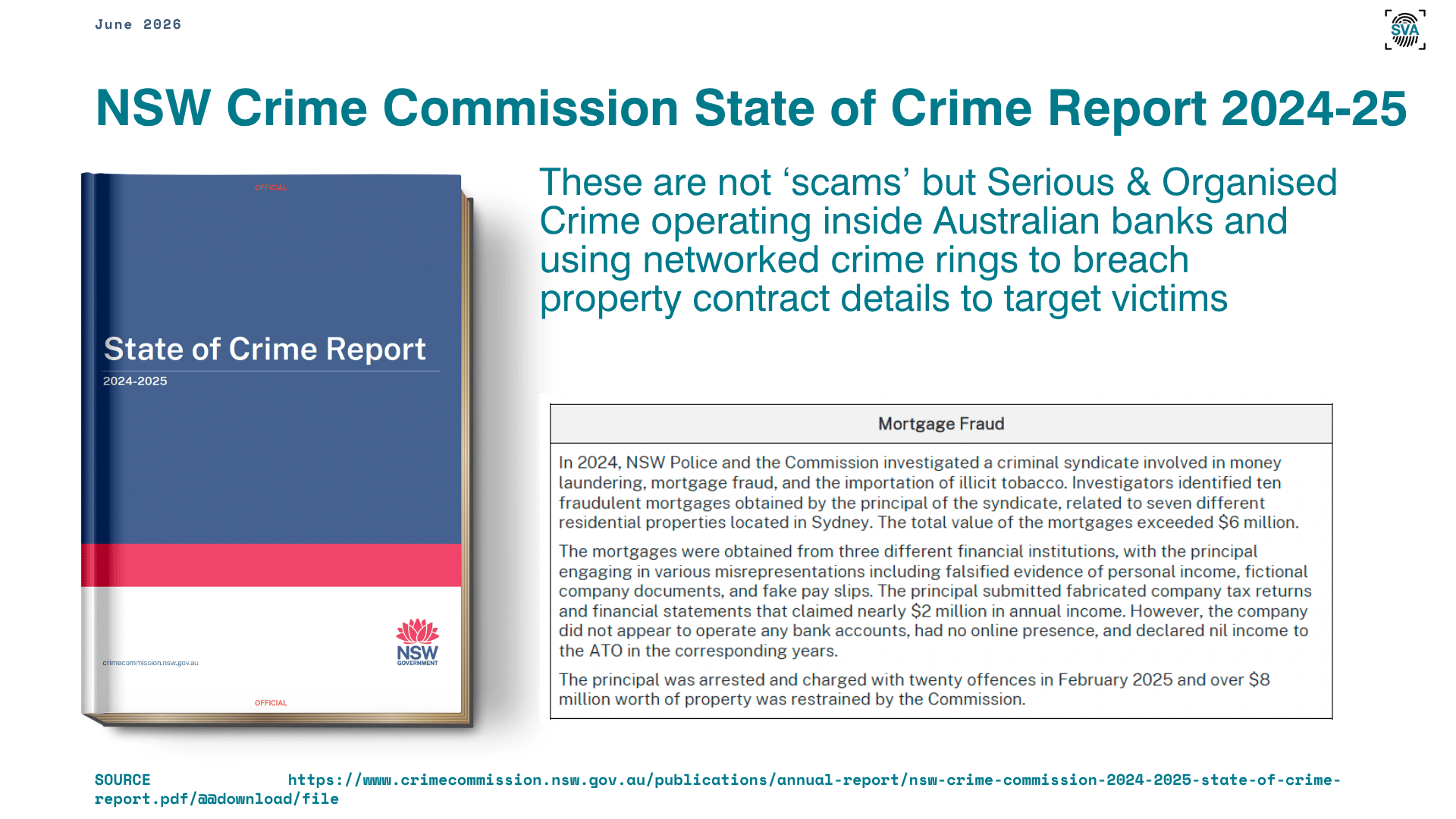
Case after case follows the same pattern: threat actors gain access to a solicitor's or conveyancer's email thread, waiting to see the property contract details before sending the buyer a fraudulent instruction with 'updated' bank details that looks identical to genuine correspondence.
In each of these matters, and in others our organisation is aware of, the homebuyer or seller followed the process their solicitor told them to follow, using the same email thread they had used throughout the transaction.
4. Lawcover's dual role creates a structural conflict of interest that leaves victims with nowhere to go
Because Lawcover is the near-universal insurer for solicitors in this State, and is wholly owned by the Law Society of NSW, the same body responsible for regulating the profession, a defrauded homebuyer faces a single gatekeeper who is simultaneously the insurer assessing the claim, financially interested in denying it, and structurally connected to the regulator meant to hold the profession to account. There is no competing insurer to approach, and no independent forensic body a claimant can turn to for a second opinion. The NSW Conveyancers Institute runs a similar monopoly and also denies claimants.
In the matters our organisation has reviewed, Lawcover investigates using its own or the law practice's chosen IT contractor, concludes there was 'no evidence' of email compromise, denies liability, and threatens the claimant with an adverse costs order if they do not withdraw. Correspondence sent by Lawcover states plainly that Lawcover 'sympathise[s] for the loss suffered by them due to the fraudulent conduct of a third party', while maintaining that 'it is not appropriate to look to the law practice for recovery in relation to that loss', before warning that Lawcover and the law practice 'may... rely on this letter on the question of costs in any proceedings, including costs payable on an indemnity basis.'
A defrauded homebuyer, already out of pocket by tens or hundreds of thousands of dollars, is placed in the position of having to accept the word of the very body with a financial incentive to deny the claim, or risk a costs order if they press on. This is not a level playing field, and it is a direct consequence of the lack of competition and independence the Committee has been asked to examine.
A recurring feature of these disputes is that Lawcover's forensic denials are not independently testable by the claimant. They use a firm called Zirilio, which our forensic experts have examined and described as a 'fig leaf' covering up the sources of the email breaches, which are wide and varied.
In one matter, correspondence records that no DKIM (DomainKeys Identified Mail) authentication signature was present on the relevant messages at all, meaning there was no cryptographic basis on which anyone could rule compromise in or out, yet a firm conclusion of 'no compromise' was still communicated to the claimant and used to deny the claim. In another set of matters, doctored bank documents used to facilitate the fraud were found, on close inspection, to contain 'hidden text': invisible, embedded transaction data lifted from an entirely unrelated customer's real banking history and pasted beneath the misdirected payment instructions. There was also evidence of previous frauds involving other NSW law firms.
Where the same insurer that is assessing liability for an email-compromise claim also selects or instructs the forensic examiner, controls what is disclosed to the claimant, and holds an effective monopoly over the market the claimant must deal with, there is no independent check on the reliability of 'no evidence of compromise' findings. Competitive reform that introduces genuinely independent insurers along with independent forensic verification standards would materially improve outcomes for consumers.
Solicitors' professional indemnity insurance is usually discussed as a question of professional risk management. For the families our organisation has assisted, it has determined whether they ever see their stolen deposit or settlement funds again. A monopoly insurer, owned by the regulator, investigating itself and denying claims under threat of costs, is not a system that can be trusted to deliver fair outcomes for the growing number of Australians targeted by property payment redirection fraud. Financial and economic crime is a growing problem all over the world. In the UK, property misdirection fraud is mandatorily reimbursed within a month [8]. In Australia, there is no mandatory reimbursement. We urge the Committee to treat the consumer harm set out in this submission as central to its inquiry, and we would welcome the opportunity to provide further case material, including the underlying correspondence referred to above, on a confidential basis if that would assist the Committee.
References
[1] "INTERPOL Report Warns of Increasingly Sophisticated Global Financial Fraud Threat." Accessed 20 June 2026. https://www.interpol.int/News-and-Events/News/2026/INTERPOL-report-warns-of-increasingly-sophisticated-global-financial-fraud-threat
[2] "Scam Victim Alliance Winners 2026." The MAIAs – Money Awareness & Inclusion Awards. Accessed 19 June 2026. https://www.maiawards.org/winners-2026/
[3] United Nations Office on Drugs and Crime (2025). Survivor-informed action brief on combating fraud. https://www.unodc.org/res/organized-crime/GFS/publications/UNODC_Survivor-informed_action_brief_on_combating_fraud.pdf
[4] "Scams Prevention Framework Codes and Rules Exposure Draft." Treasury Consult Hub. Accessed 9 September 2026. https://consult.treasury.gov.au/c2026-765133
[5] "Fintel Alliance Uncovers Coordinated Mortgage Fraud across Major Lenders." AUSTRAC. Accessed 7 September 2026. https://www.austrac.gov.au/news-and-media/media-release/fintel-alliance-uncovers-coordinated-mortgage-fraud-across-major-lenders
[6] Blair Jackson, "$4bn Issue Overwhelming Aussie Banks." Yahoo Finance, 29 June 2026. https://au.finance.yahoo.com/news/4bn-issue-overwhelming-aussie-banks-051418191.html
[7] PEXA Australia, "Property Settlement Scam Awareness, Behaviours and Attitudes in Australia, 2026." Accessed 7 September 2026. https://www.pexa.com.au/content-hub/settlement-scams-index/
[8] "APP Fraud Reimbursement Protections." Payment Systems Regulator (UK). Accessed 9 September 2026. https://www.psr.org.uk/information-for-consumers/app-fraud-reimbursement-protections/